


A top Scots songwriter turned up to the Scottish Album of the Year Awards styled as a futuristic android pop star – in a dramatic warning against the rise of AI use in music.
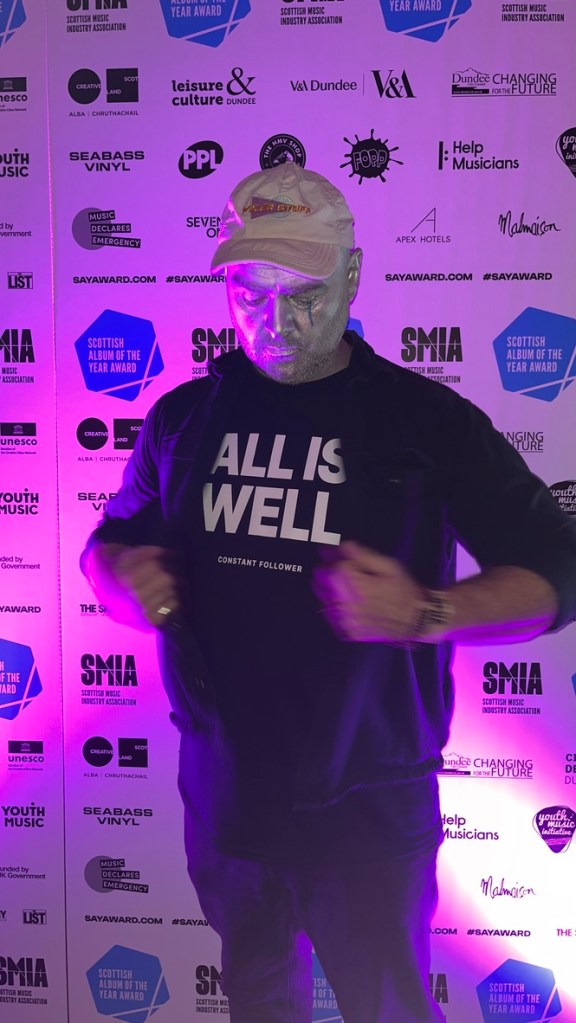
SAY Award nominee Stephen McAll, of experimental folk group Constant Follower, attended the £20,000 prize ceremony at Dundee’s Caird Hall with his head painted silver and a single electric blue tear down his cheek.
The image was a quiet nod to what will be a deep shift in how songs are written and recorded.
Award-winning Stephen says he believed this year’s SAY Awards could mark a defiant last stand for human-made music against sound created by AI.
“I went to the SAY Awards this year to celebrate the best album of the year,” McAll says. “Records by Kathryn Joseph and Lomond Campbell, Andrew Wasylyk and Tommy Perman, Jacob Alon, Hamish Hawk and Matt Carmichael.
“I wanted to be in a room with work that I know came from lives lived, from rooms and instruments and voices. That matters to me.”
“At the same time, I felt a sense of grief. Because from this point on, AI will be inside more and more of the music we hear. Not as a distant idea, but the everyday reality of how a lot of songs are made, maybe even already ahead of some of our best chart writers.”
He stresses that he is not against technology. His concern is that the scale and quality of AI songwriting is not yet being faced honestly and society and government is failing to act swiftly enough to safeguard against it or new music generating platforms like SUNO.
“I just spent two days working with the new professional model of SUNO AI,” he says. “I could create a professional, studio quality, finished track every two minutes.
“For pop, house and rap, those songs were as good as what we hear in the charts. They had interesting structure, hooks, tiny details, perfect vocals, tight instrumentation and layers that would normally take a musician and producer weeks, months or years to write and build.”
“I’m a professional songwriter. My view is that, in these genres, the AI is already ahead of our best human writers. Not at some point in the future. Now. And next year’s versions, or perhaps next week’s version, will be more powerful again.”
Every artist he has shown the app to, he says, shares the same mixed reaction.
He added: “People are amazed, terrified and just dejected at the same time. You spend years learning your craft. Then a free app gives you a better, cleaner, more interesting version of your sound in seconds. There is admiration in that, to some extent. There is also a real sense of loss.”
A small test at home brought the picture into sharp focus for him. “I sat with my six-year-old daughter and let her use SUNO for a couple of hours,” McAll explains. “She made songs about her friends, about school, about very ordinary parts of her life. Then the AI instantly turned those ideas into fully produced pop tracks that easily matched what you hear in the charts.”
“For the next week, that was all she wanted to listen to. Not radio. Not playlists. Just her songs. That is how powerful this is. How addictive.
“Once you have music that sounds that good and is about your own life, it becomes very hard to care about distant stars in the same way. AI is making music that makes you feel. Deeply. I never thought I would be able to say that.”
For McAll, this points towards the end of a single, shared central reference point in popular music.
“The future looks like small circles of sharing,” he says. “Kids will make the songs they want to hear and share them with their friends. Adults will do the same. Those songs will carry more meaning for them than mainstream releases. Very few of those tracks will leave those circles, but they will be what matters to the people who made them.”
“In that context, the current business model of chasing a handful of huge global hits may collapse. Pop as a mass commercial product may disappear completely. Why would people spend money on commercial music that is worse and less meaningful than the songs they can churn out about their lives?”
Despite the scale of the shift, McAll does not believe that all corners of music are equally at risk.
“I do not think music itself is in danger,” he says. “If anything, there will be more of it. But the balance will change. I think there will be a strong movement towards live music and towards physical medium like vinyl records and CDs. A lot of people will turn away from AI-generated songs and will actively look for real rooms, real players, and objects they can hold.”
“The music I make and listen to is slower, more personal, more about the deep reality of being alive. It comes from a deep place. A life lived. I think work like that will thrive.
“People will keep coming to it for the same reasons they always have. To feel understood. To make sense of their own life by comparison. To share time. To sit with something that took care and time to make.”
“So this is not a story about everything ending. It is a story about things changing very quickly.”
“AI is already here in our creative lives,” he says. “It is in the browser on my desk. It is in my child’s headphones. This is not an idea for a panel in five years’ time. It is shaping how people write and hear songs today.”
“We need to start planning for a landscape where large-scale commercial pop recording is gone, and where live music, grassroots venues, independent labels, record shops and artist-owned catalogues become even more central. Some of that work is already happening. AI will push it faster.”
“If we can accept where we are, Scotland has a chance to build an ecosystem where human-made music thrives in real spaces and communities, even as the online world fills with machine-made songs.
“That is the conversation I hope we can now begin.”
Human made music was to the fore at the awards with live performances from the likes of KT Tunstall, Brooke Combe and others at the event hosted by the Scottish Music Industry Association.
Glasgow based Kai Reesu picked up the £20k top prize for their release KOMPROMAT vol.i
Photo: Kevin Linnett
 Skog Media Associates